The intention behind the Garment Making Workshops was to bring Afghan and Ukrainian women together to create a garment through shared making, storytelling and collaboration. A garment that would hold pieces of their culture, identity and lived experience. From the very first session, it became clear that this process would open up space for connection, exchange and discovery between the two groups.
The workshops were led by artists Cee Boulaqui and Mah-E-Nau Rafiq, both bringing distinct styles and technical skills to the project. The Creative Crawley team helped co-ordinate and support; it was important to the whole team that the participants felt welcome and able to express themselves. Over four weeks, Unit 79/80 became enlivened with laughter and creativity.
Bringing together people who didn’t speak the same language was a new venture for the team, especially when facilitating a space where communicating was essential to the process. With the support of West Sussex County Council we were able to work with Interpreters so that the artists and participants were able to communicate and share their languages. It became clear that creativity was key to discovering alternative ways to communicate visually; this way of working encouraged an authentic collaboration.
Cee and Mah-E-Nau began the workshops by sharing images they had gathered through their research: traditional dresses, embroidery techniques, motifs, colours and home interiors. Mah-E-Nau describes this moment as one where both groups could “step into the world of each other, quickly finding some similarities.”
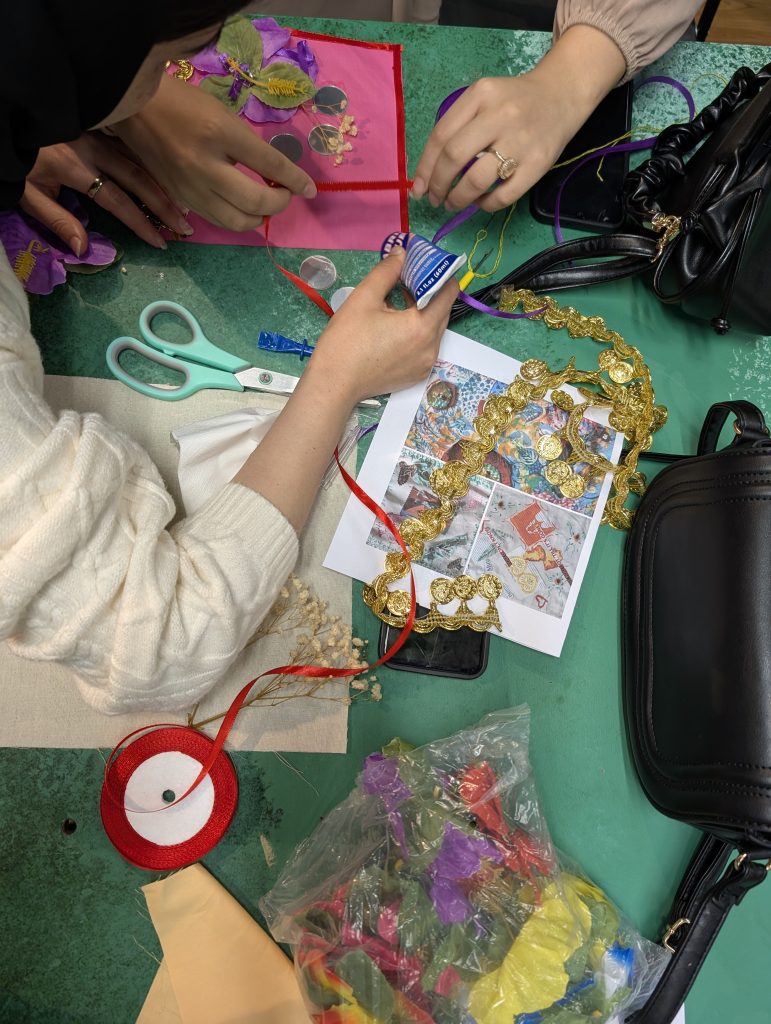
Participants working collectively to decorate squares of fabric
The participants were keen to get making, and were given the task of creating a fabric square reflecting their feelings about their culture. The distinct techniques shone through – the Afghan participants brought experience with mirror work, coin detailing and fine embroidery. The Ukrainian participants were skilled in clean stitching, cross stitch and very structured handwork. It was beautiful to notice the same geometric flower appearing in Afghan and Ukrainian textiles. These squares became key components of the final design, making up the colourful bodice of the dress.
Cee and Mah-E-Nau worked closely with the participants as the weeks progressed to ensure that the final garment was a balanced reflection of both cultures. They asked for the group’s opinion on material, shape and placement. The white linen represented Ukraine through its structure and simplicity, while the Afghan culture shone through the decorative elements such as mirrors, coins, colour and pattern. Bringing these two visual languages together through careful placement kept both identities visible and balanced throughout the garment, and also provided an opportunity for the group to learn from one another. As one participant shared, “I couldn’t do the cross stitch but now I’ve learned — it’s been a good opportunity to come out and be in the community.”
The most successful session was the construction of the sleeves. Each sleeve was spread out on a central table, with the Ukrainian participants working on one, and the Afghan participants on the other. They added Afghan detailing onto a Ukrainian background and worked together to layout and measure everything precisely. The spacing had to be exact and they managed it beautifully without an interpreter, relying entirely on eye contact, gesture and shared concentration. The artists stepped back, and let them work, simply observing as the passion and care from both cultures created something beautiful. “Even with three spoken languages in the room, the women communicated effortlessly through making.” says Mah-E-Nau. They were gentle and patient with each other, communicating by watching each other’s hands, copying stitches and sharing tools with complete ease. It was magical to observe the closeness and connection that comes when people come together to be creative.
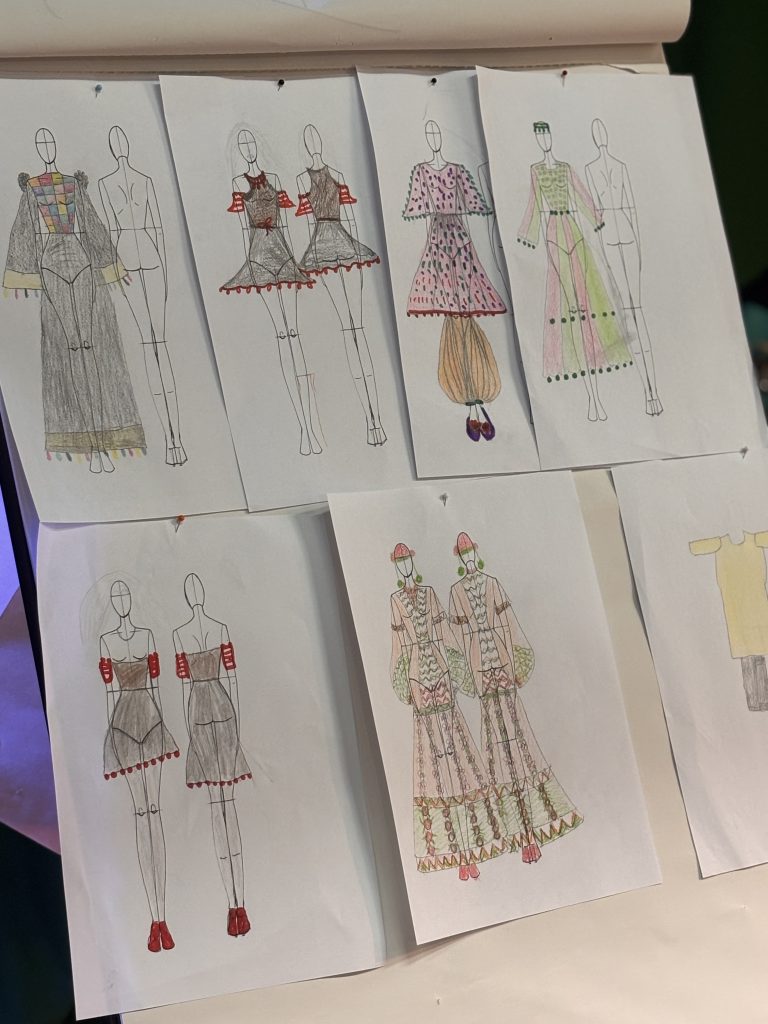
Drawings done by the participants which helped inspire the shape of the garment
As the participants began to feel more comfortable in the space, conversations sparked around the comforts and the challenges that come with life in Crawley. For many participants, displacement and being separated from family is part of their lived experience and reality. One participant shared that “the most crucial thing is that we live here in peace and quiet away from danger.” For some participants, it was clear the workshops offered calmness and purpose: “It distracts, it’s not boring — we lack opportunities to go out a lot,” one woman explained.
The final garment is a dress defined entirely by the two cultures which inspired it, through techniques already present in their cultures. The bodice and sleeves draw from traditional Afghan silhouettes, while the skirt and white linen takes inspiration from Ukrainian dress. They used embroidery, tassel making, pom pom making, wreath making for the floral headpieces, crochet, appliqué and cross stitch. The dress tells a story of dedication and commitment – each stitch carefully threaded, each pompom made with skilled hands, each beaded flower holding stories and commonalities across the two groups. It is a glowing product of proof that two cultures separated by history, language, and birthplace can absolutely come together to share their skills and passion to create art.
The team learned a lot from the participants in these sessions. As Cee reflects “What I learned from them is that creativity becomes its own language… We learned that crafts are not just skills.” When asked what the workshops meant to them, participants responded with words like “wonderful,” “happy,” and “very thankful,” echoing the sense of care and connection that shaped the project. We all learned that textiles can become a common language, part of identity and lived experience.
Thank you to everyone who made this project such a success.
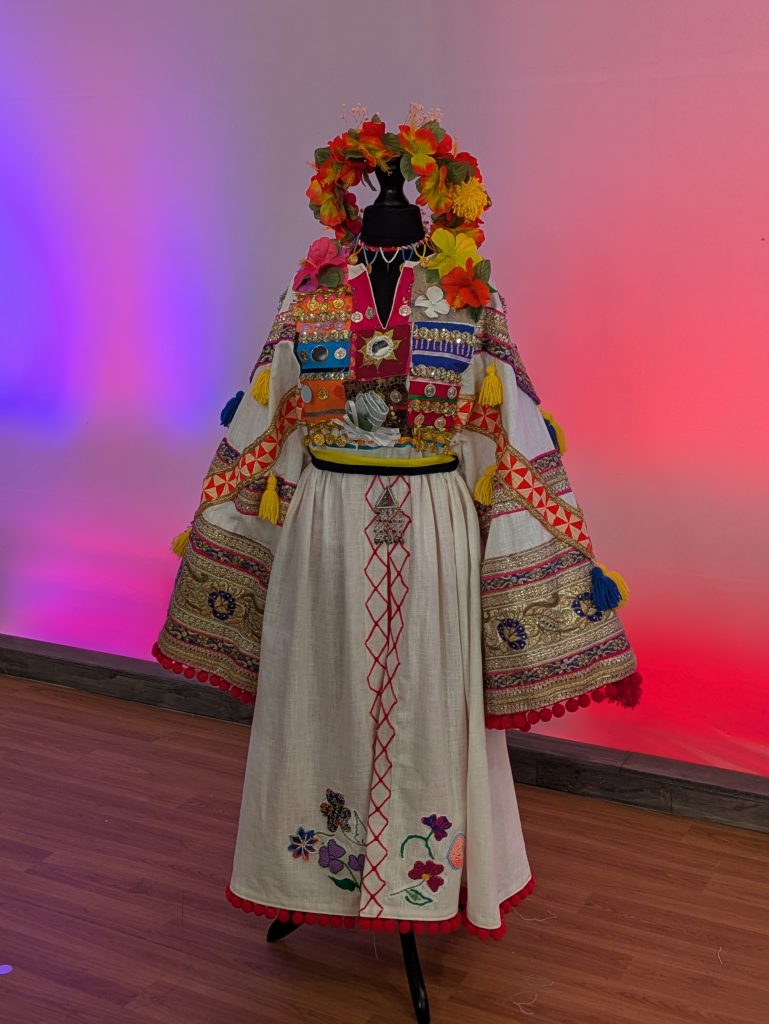
The final garment created at the end of the project